
BOOK RELEASE DATE
AVAILABLE TO ALL CUSTOMERS AND USERS OF THE SYSTEM
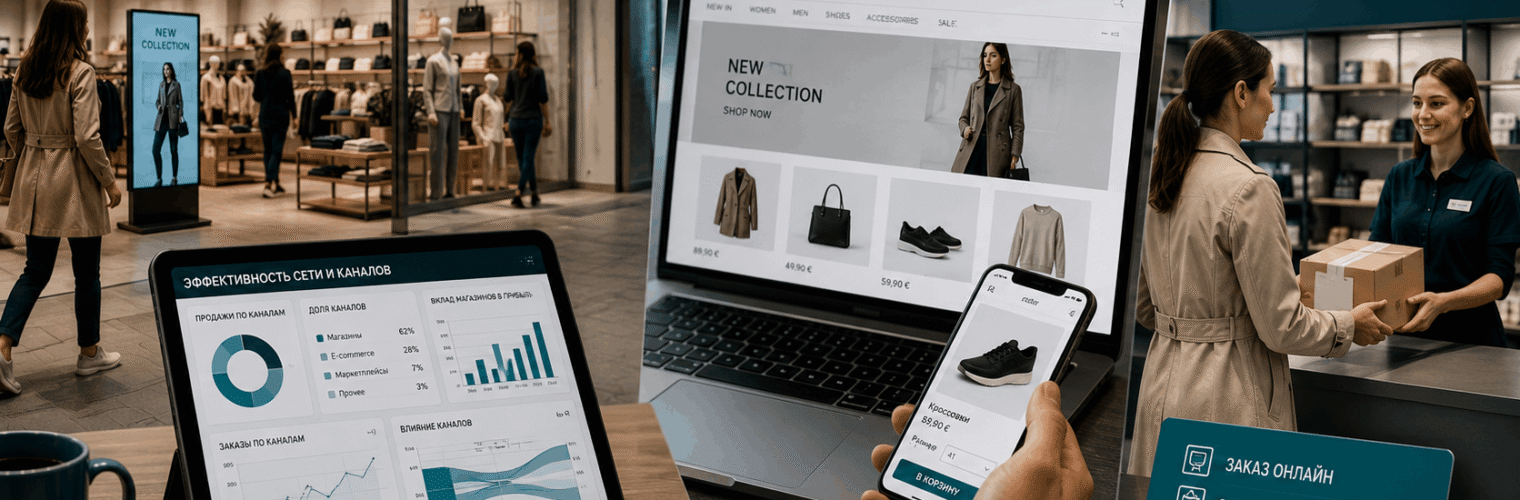
Retail businesses are no longer built around physical stores alone. Customers may discover a product online, check its availability at a nearby store, visit the store, place an order through the website, collect it in person and later make another purchase online.
For retailers, this means that physical stores and e-commerce can no longer always be evaluated as completely independent sales channels. They may compete for the same transaction, complement one another, or jointly create value throughout a single customer journey.
This is why retail store and channel performance should be evaluated as an integrated system.
The objective is not simply to identify which store or channel generates the most sales. The more important questions are where economic value is created, what factors drive the result, how different channels influence one another, and what role each store and channel should play in the overall retail model.
Retail store performance is not simply the sum of individual store results. Effective analysis needs to consider several levels simultaneously.
The first is the performance of each individual store: sales, gross margin, operating costs, traffic, conversion rate and space productivity.
The second is channel performance: physical stores, e-commerce and other sales channels used by the retailer.
The third is the interaction between channels. One channel may generate revenue directly while also contributing to sales, fulfilment or customer acquisition in another channel.
For example, a store may have relatively modest direct sales but still play an important role as a click-and-collect location, returns point, fulfilment hub or physical touchpoint for online customers. Evaluating that store only through its POS sales would therefore provide an incomplete picture.
The key management question is not simply “How much did this store sell?” It is “What contribution does this store and channel make to the overall retail business?”
Typical KPIs include sales, gross margin, operating profit, traffic, conversion rate, average transaction value, sales per square metre, labour productivity and operating costs. For omnichannel retailers, cross-channel interactions and the store’s contribution to online fulfilment should also be considered.
High sales do not necessarily mean high efficiency. A store may generate substantial revenue while also having high rent, a large footprint, significant operating costs or low margins. Sales should therefore be evaluated alongside profitability, costs, space productivity and other relevant drivers.
The first level of analysis is the individual store. The objective is to understand how effectively each location converts its customer traffic, selling space and operating resources into financial results.
A typical store performance framework includes sales and gross margin, sales growth, like-for-like performance, traffic, conversion rate, average transaction value, sales and profit per square metre, and operating costs.
However, even a comprehensive KPI set does not automatically explain why performance changes.
Suppose a store’s sales decline by 8%. The decline identifies a problem, but it does not explain it. Further analysis needs to establish whether the decline resulted from lower traffic, weaker conversion, a smaller basket, stock availability issues, assortment changes or other operational factors.
If traffic remains stable while sales decline, the problem may be inside the store. If both traffic and sales decline, external factors such as changes in the competitive environment, location attractiveness or customer behaviour may need to be investigated.
Store performance analysis should therefore move from measuring the result to identifying its drivers.
The first step is to decompose the change in sales into key drivers such as traffic, conversion rate and average basket value. The analysis should then examine stock availability, assortment, pricing, promotions, customer behaviour, competitive conditions and operational factors.
Absolute sales are not sufficient for comparing stores of different sizes. Productivity measures such as sales or gross margin per square metre make comparisons more meaningful. Store format, location, assortment and customer mission should also be considered.
Retail space is one of the most constrained and expensive resources in physical retail. The relevant question is therefore not only how much a store sells, but how effectively each square metre contributes to the business result.
Sales per square metre is a common measure of store productivity because it allows retailers to compare locations with different footprints.
However, sales density alone does not provide a complete picture.
A store may generate high sales per square metre through aggressive discounting while producing relatively weak margins. Another store may have lower sales density but generate stronger gross margin and contribution because of a different assortment or customer profile.
Space productivity should therefore be evaluated alongside:
The same principle can be applied within the store. If a category occupies significant selling space but generates relatively little sales or profit, the retailer may need to reconsider the allocation of space, assortment or merchandising.
Compare the space allocated to a category or store with the sales, gross margin and other relevant performance measures it generates. Persistently low productivity may indicate an opportunity to change the assortment, layout, merchandising or space allocation.
No. A larger footprint can support higher sales but also creates higher occupancy and operating costs. In some locations, a smaller format may deliver stronger sales density, lower costs and better overall economics.
E-commerce should not be evaluated solely through order volume or online revenue.
Between an online transaction and its final financial contribution are several additional cost components, including customer acquisition, order processing, picking, fulfilment, delivery and returns.
For this reason, retailers need to distinguish between online sales growth and e-commerce profitability.
An increase in online revenue may initially look positive, but if it is accompanied by higher acquisition costs, expensive fulfilment, increased delivery costs or rising returns, the improvement in revenue may not translate into a comparable improvement in profit.
A useful e-commerce performance framework can therefore include traffic, conversion rate, average order value, sales, gross margin, customer acquisition cost, fulfilment and delivery costs, return rates and contribution margin.
Depending on the business model, retailers may track website traffic, conversion rate, order volume, average order value, revenue, gross margin, customer acquisition cost, fulfilment and delivery costs, return rates and contribution margin.
Sales may grow faster than profit when discounts, acquisition costs, fulfilment expenses, delivery costs or returns increase at the same time. Revenue growth therefore needs to be evaluated together with the economics of each order and customer.
In an omnichannel model, the same customer may use several channels during a single purchase journey.
A customer may research a product online, visit a store to see it in person, place the order online and collect it from the store. Another customer may buy in a physical store today and make the next purchase through the retailer’s website.
This creates an important attribution challenge: which channel should receive credit for the result?
An online order collected in a store is an e-commerce transaction, but the store also provides an operational service and a customer touchpoint. Conversely, an online product search may influence a later in-store purchase.
The objective of omnichannel analysis is therefore not to eliminate channel-level reporting. Each channel still needs its own economics and KPIs. The objective is to understand how those channels work together.
This requires a distinction between channel revenue and channel contribution.
Revenue identifies where the transaction was completed. Contribution considers the broader role a channel played in creating, fulfilling and retaining the customer relationship.
Omnichannel performance measures how effectively different sales and customer touchpoints work together to create value for both the customer and the retailer. It considers channel sales as well as customer movement between channels, fulfilment, returns and other cross-channel interactions.
Its role should not be assessed solely through in-store sales. If the store handles picking, collection, delivery support or returns for online customers, those activities form part of its contribution to the wider retail system.
For omnichannel retailers, it is useful to move beyond individual transactions and analyse customer journeys and cross-channel behaviour.
Relevant questions include:
This analysis can reveal that the same customer creates value across several touchpoints.
It also highlights why last-touch attribution can be insufficient for omnichannel retail. The channel in which a transaction is completed may not be the only channel that contributed to the purchase.
For example, an online order may be placed on the website, picked in a store and collected by the customer at that same location. The website records the sale, while the store carries operational workload and creates another opportunity for customer interaction.
A management model therefore needs to distinguish between the sales channel, fulfilment channel and customer touchpoints involved in the transaction.
Retailers should define clear attribution rules and distinguish between transaction ownership, fulfilment activity and customer interaction. A single transaction should have one recognised sales value, while several channels may receive operational or customer-level attribution.
They should be integrated at the business level when the retailer operates an omnichannel model. However, integration should not replace channel-level reporting. Retailers need to see both the standalone economics of each channel and their combined contribution.
Individual stores rarely have identical economics. Performance varies because of location, size, format, assortment, customer traffic, competitive environment and stage of development.
This means that after analysing individual stores, retailers need to move to store network performance and evaluate the network as a portfolio.
Stores can be grouped according to their economic and operational characteristics. Some may be high-performing growth assets, others may deliver stable results, while some may show persistent underperformance.
However, simply ranking stores by revenue is not enough.
Stores should be compared in the context of their format, size, location, cost structure and role in the wider network. A store that appears weak on direct sales may still have an important strategic role because it serves a key location or supports a significant volume of online orders.
The objective is therefore not to create a simple ranking of stores, but to understand the economics and role of each location within the network.
Analyse sales and profitability together with sales trends, traffic, conversion, space productivity, operating costs and the store’s role in the omnichannel model. Persistent underperformance is more significant than a temporary decline.
High sales alone are not enough. Development candidates should combine attractive economics with growth potential and a strategically relevant role in the network. Location, market potential, format, costs, space and competitive conditions should all be considered.
One of the most valuable applications of store network analysis is making decisions about the future portfolio.
Opening a new store requires more than estimating potential sales. Retailers need to evaluate market demand, location characteristics, store format, footprint, competition, expected margins and operating costs.
Relocating a store requires understanding how much of its current performance is generated by the location itself and how much comes from its format, assortment and customer base.
Closing a store requires an even broader assessment.
The relevant question is not simply whether the store is profitable. Retailers also need to consider what will happen to its customers and sales after closure. Some demand may migrate to nearby stores, some may move online, while some may be lost altogether.
This makes cannibalisation and demand migration important elements of network planning.
A new store can increase its own sales while simultaneously taking sales away from existing locations. The correct measure is therefore the impact on the entire network, not the gross sales generated by the new store alone.
Closure may be appropriate when a store consistently fails to achieve the required economics and has limited strategic or omnichannel value. Before closing it, however, retailers should assess whether a different format, smaller footprint, assortment change or relocation could improve its performance.
The analysis should combine market demand, location characteristics, format, footprint, assortment, competition and operating costs. It should also estimate cannibalisation of existing stores and potential effects on e-commerce demand.
A comprehensive store and channel performance system requires more than a long list of KPIs. It needs a hierarchy that connects financial outcomes with their operational drivers.
At the highest level are business outcomes such as sales, gross profit and operating profit.
The next level covers channel and store performance.
Below that are the drivers of performance: traffic, conversion, basket size, assortment, stock availability, pricing, promotions, space and operating costs.
For an omnichannel retailer, an additional layer captures interactions between channels: cross-channel customer behaviour, click and collect, returns and the use of stores for online fulfilment.
This creates a causal analytical chain:
financial result → channel → store or customer journey → operational driver → root cause → management action.
This is what turns a collection of KPIs into a management system.
There is no universal number. The KPI framework should reflect the decisions managers need to make. The objective is not to maximise the number of metrics, but to provide enough information to identify performance, drivers and potential actions.
A core framework usually includes sales, profit, sales growth, traffic, conversion rate, average basket value, sales or profit per square metre and operating costs. Depending on the retail model, assortment, availability and omnichannel fulfilment metrics may also be required.
The most common analytical mistake is treating performance indicators as independent variables.
For example, a decline in store sales may not indicate weaker store execution if the underlying cause is poor stock availability. Online sales growth may look like a success while the economics of fulfilment deteriorate. A new store may appear highly successful while actually taking a significant share of sales from existing locations.
Several approaches create this problem:
The underlying problem is the same in every case: a performance indicator is being analysed without considering the system that produced it.
Sales can grow while margins decline, operating costs increase or inventory efficiency deteriorates. Sales growth therefore needs to be analysed together with profitability and the factors that generated the increase.
The objective is not simply to rank stores or produce another KPI report. The real outcome is an understanding of which stores and channels create economic value, why their performance differs and what actions can improve the overall network.
A strong performance management system should end with a decision, not with a report.
If a store has low space productivity, management needs to determine whether the problem is caused by its footprint, assortment, layout, customer demand or another factor.
If e-commerce sales are growing, the next question is whether the growth creates incremental profit and whether the existing store network can support fulfilment efficiently.
If one store format significantly outperforms others, management needs to identify which characteristics drive the result and whether they can be replicated elsewhere.
If a store consistently underperforms, the business needs to determine whether the problem is temporary and correctable or structural and related to the location or format.
This is why retail store and channel performance should not be treated as a reporting exercise. It should provide the analytical foundation for management decisions.
A practical decision-making sequence is:
This approach moves retail management from performance monitoring to active performance improvement.
An effective retail network is not necessarily the one with the largest number of stores or the highest share of online sales.
It is a system in which each store has a clear economic role, retail space is used productively, store formats match customer demand, and online and offline channels complement one another where doing so creates value.
To manage such a network, retailers need to see several dimensions simultaneously:
The result is a more complete view of retail performance: not simply where a sale happened, but where value was created, what drove it and what the retailer can do to improve the system.
Retail store and channel performance should be evaluated as part of one interconnected retail system.
Physical stores, e-commerce and omnichannel operations have different economics and should retain their own performance measures. At the same time, their interaction needs to be visible in management analysis.
The most useful framework connects financial results with their underlying drivers: traffic, conversion, basket size, assortment, availability, pricing, space productivity, operating costs and customer behaviour.
When these relationships are understood, performance analysis becomes more than a way to identify high- and low-performing stores. It becomes a practical method for deciding which formats to develop, where to invest, how to allocate retail space, when to relocate or close stores, and how to make the online and offline network work as one system.
For Retonomix, this is the central principle of retail performance management: measure the result, understand its drivers, identify the cause and connect the analysis to a management decision.
Continue exploring related Retonomix articles on retail performance, sales and customer analysis, store operations, assortment, inventory and data-driven retail management.
AVAILABLE TO ALL CUSTOMERS AND USERS OF THE SYSTEM

