
BOOK RELEASE DATE
AVAILABLE TO ALL CUSTOMERS AND USERS OF THE SYSTEM
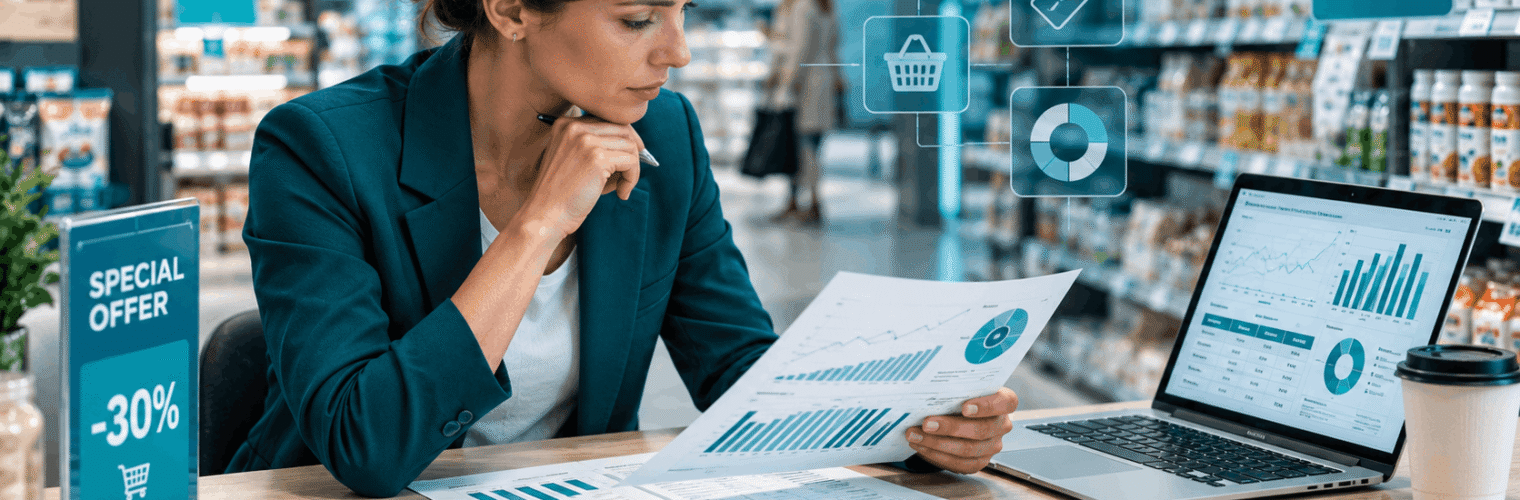
Price and promotion decisions have a direct impact on retail sales, but their commercial effect is not always reflected in revenue growth. A promotion may increase sales because it creates genuine incremental demand, shifts customers from competing products, brings purchases forward, or simply discounts sales that would have happened anyway.
This makes retail pricing strategy more than a question of setting prices or choosing discount levels. It is a management discipline focused on understanding how pricing and promotional decisions affect demand, margin and profit.
For retail executives, the key question is therefore not simply how much was sold during a promotion. The more important questions are: how much incremental demand did the promotion create, what did it cost in margin, what other sales did it affect, and did it ultimately generate additional profit?
Pricing and promotion form an integrated system for managing customer demand.
Price establishes the economic conditions of a purchase, while promotions temporarily change those conditions to influence customer behaviour. As a result, a price change can affect several aspects of retail performance at the same time:
A price reduction therefore cannot be evaluated solely by looking at units sold.
For example, suppose a product sells for €10 and 1,000 units are sold in a normal period. The retailer reduces the price to €8, and sales increase to 1,400 units.
At first sight, the result appears positive: unit sales are up 40%.
However, revenue has increased only from €10,000 to €11,200. If gross margin per unit has fallen significantly, the financial result of the promotion may be worse than under the regular price.
This is why sales growth and promotion profitability are not the same thing.
Yes. If the additional margin generated by incremental volume does not compensate for the value of the discount and other relevant costs, a promotion can increase sales while reducing profit.
Promotions can generate a substantial short-term increase in sales. However, that additional volume can come from very different sources.
Some customers may buy more than they normally would. Others may bring a planned purchase forward. Some may switch from another product or brand. Others may have purchased the promoted product anyway, meaning that the retailer has simply given them a discount on existing demand.
These situations have very different economic implications.
A promotion should therefore be assessed not only through its sales uplift, but through the underlying source and economic value of that uplift.
The analysis should determine:
Sales uplift answers only one question:
How much did actual sales differ from the expected baseline?
It does not, by itself, establish whether the promotion was commercially successful.
The optimal retail price is not necessarily the highest possible price or the price that generates the greatest sales volume.
The objective is to find the price point that produces the most attractive overall economic outcome.
A price increase may reduce unit sales. However, if the decline in volume is relatively small, the higher selling price can increase revenue and gross profit.
Conversely, a price reduction may generate additional volume, but that volume may not be sufficient to compensate for the lower margin per unit.
The fundamental relationship can therefore be expressed as:
Price → Demand → Sales → Margin → Profit
In practice, the analysis also needs to account for assortment, seasonality, store format, competitive conditions and customer behaviour.
This is where a robust retail pricing strategy differs from a simple cost-plus pricing rule or a universal markup.
One of the key concepts in retail pricing is price elasticity of demand.
Price elasticity measures how strongly demand responds to a change in price.
In simplified form:
Price elasticity = % change in demand / % change in price
If a small price change produces a significant change in sales volume, demand is relatively price-sensitive.
If sales change only slightly, demand is less sensitive to price.
However, retailers should not assume that one elasticity coefficient applies to the entire assortment. Price sensitivity can vary substantially across products and categories.
It can be influenced by:
The objective of pricing analysis is therefore not simply to calculate an elasticity figure. It is to understand where, when and under which conditions customers respond to price changes.
No. Price sensitivity can differ significantly between products, categories, stores and customer groups. Historical sales and price data should be analysed at an appropriate level of detail before applying pricing decisions across the assortment.
A common analytical mistake is to evaluate a price change only at SKU level.
In real retail environments, products compete for the same customer demand.
If one product becomes cheaper, customers may switch from another product within the same category. The promoted SKU therefore gains sales, while total category demand may change much less.
Consider a supermarket promoting one coffee brand. Sales of the promoted SKU increase, but some customers may have switched from another coffee brand that they would otherwise have purchased.
The result is positive at SKU level but potentially much less significant at category level.
For this reason, price and promotion analysis should, where appropriate, be performed across multiple levels:
SKU → Brand → Category → Store → Retail chain
This makes it possible to distinguish between genuinely incremental demand and demand that has simply been redistributed.
A promotion should be evaluated against what would have happened without the promotion.
This expected level is commonly referred to as the sales baseline.
Suppose a product normally sells 1,000 units, while 1,400 units are sold during a promotion. It would be incorrect to automatically classify all 400 additional units as incremental sales.
If the estimated baseline is 1,100 units, the incremental volume is:
1,400 − 1,100 = 300 units
Those 300 units provide the starting point for evaluating the promotion.
But even this does not provide the complete answer.
The next question is:
Where did those 300 incremental units come from?
They may represent:
This is why effective promotion analytics needs to examine not only uplift, but also its underlying sources.
A critical distinction in promotion analytics is the difference between incremental sales and incremental profit.
Incremental sales represent sales above the expected baseline.
Profit requires a broader economic calculation that incorporates selling price, cost of goods, margin and the cost of the promotion.
In simplified terms:
Incremental profit = incremental margin − discount cost and other relevant promotion costs
Suppose a promotion increases unit sales by 30%, but reduces the average selling price by 20%. The additional volume may not be sufficient to compensate for the lower margin per unit.
This is why Promotion ROI should be evaluated together with:
Moving from Sales Uplift to Incremental Profit is an important step in turning promotional reporting into a commercial decision-making tool.
Profit should be the primary measure of economic effectiveness. Revenue and sales volume remain important for understanding demand, but they do not show whether the additional sales compensate for the discount.
Promotion cannibalisation occurs when an increase in sales of one product is accompanied by a reduction in sales of another product because customers switch between them.
This is particularly important when evaluating promotional pricing.
Suppose a retailer promotes a particular coffee SKU and sells 500 additional units. At the same time, sales of another SKU from the same brand fall by 150 units.
The promoted product appears to have generated 500 additional units, but part of that increase is actually a transfer from another product.
The same principle applies across brands, pack sizes and related categories.
Cannibalisation can occur between:
This is why analysing only the promoted SKU can materially overstate the true incremental effect of a promotion.
No. Some level of switching can be commercially acceptable if the promoted product has a stronger margin position or the promotion achieves another strategic objective. The key is to measure the net economic effect rather than treating cannibalisation as an isolated negative indicator.
The interaction between products is not always negative.
A promotion can also increase sales of complementary products.
For example, a promotion on pasta may increase demand for pasta sauce. A discount on a coffee machine may increase sales of coffee capsules. A promotion on a main product can therefore create additional value elsewhere in the customer’s basket.
Promotion analysis should identify both:
Promotion → lower sales of related products
and
Promotion → higher sales of complementary products
The commercial question is therefore not simply whether a promoted SKU gained sales, but how the overall category and basket economics changed.
A deeper discount does not automatically mean a more effective promotion.
Suppose a 10% discount increases sales by 25%. Increasing the discount to 20% may increase volume further, but there is no reason to assume that sales will increase proportionally.
At the same time, every additional percentage point of discount reduces margin.
The commercial relationship can therefore be expressed as:
Discount depth → Demand response → Incremental volume → Margin loss → Incremental profit
The objective is not to maximise sales uplift. It is to identify the range in which an additional discount creates sufficient incremental demand and profit to justify the margin sacrifice.
This also means that discount depth should not necessarily be standardised across the entire assortment. Products with different price elasticity, category roles and margin structures may require different promotional approaches.
Promotions can have effects beyond the immediate promotional period.
When a product is regularly discounted, customers may begin to perceive the promotional price as a normal or expected price. The regular price may then become less attractive, while customers learn to wait for the next promotion.
This creates a potential dependence on promotional sales.
Therefore, analysis should consider not only the results of an individual promotion, but also:
Otherwise, a temporary sales increase may be mistaken for sustainable demand growth.
A comprehensive retail pricing strategy requires demand and financial indicators to be analysed together.
Key measures include:
The objective is not simply to build a long list of KPIs. The important task is to establish the causal relationships between them.
For example, a decline in gross margin may not be an isolated financial problem. It may be caused by a higher share of promotional sales. The increase in promotional sales may itself be a response to weaker underlying demand. That weaker demand may have resulted from pricing, seasonality, competitive activity or assortment changes.
This chain of relationships allows a retailer to move from identifying an outcome to identifying its cause.
There is no single analytical level that is sufficient for every pricing question.
At SKU level, the retailer can assess the response of an individual product to a price change.
At category level, it becomes possible to determine whether a promotion generated additional category demand or simply shifted sales between products.
At store level, the retailer can identify whether the same promotion performs differently across locations.
At chain level, management can evaluate the total financial impact against broader commercial objectives.
Additional analysis may be required by:
This matters because the same promotion can produce very different outcomes across stores or customer groups.
Pricing and promotion cannot be managed independently from the rest of retail operations.
A price change affects demand. Demand affects inventory requirements. A promotion increases the need for product availability. Assortment decisions influence price architecture and product substitutability.
For example, a successful promotion can create a stockout precisely when customer demand is at its highest. The retailer then loses potential sales because inventory was not aligned with the expected promotional uplift.
Conversely, a promotion designed to clear excess inventory may improve stock levels but deliver a poor financial result if the discount is too deep.
This is why a more complete analytical model connects:
Price → Demand → Sales → Availability → Margin → Profit
The same principle applies to the broader retail management system. Sales, assortment, inventory, pricing, store performance and financial results should be interpreted as interconnected elements rather than independent reports.
The value of pricing and promotion analytics is not limited to reporting what happened after an activity has ended.
A more mature approach uses historical evidence to improve future decisions.
It can help retailers:
Pricing and promotion therefore become part of commercial planning rather than a series of isolated campaigns.
Instead of asking:
“Which promotions generated the highest sales uplift?”
the commercial team can ask:
“Which pricing decisions create incremental profit, and under what conditions?”
That is a fundamentally different level of retail management.
A practical analytical framework should connect three levels of decision-making.
What happened to sales, prices, discounts, margin and profit?
Why did the result change?
How did price, promotion, demand, assortment, seasonality, store characteristics and other factors contribute to the outcome?
What should change as a result?
This could mean adjusting:
This approach reflects the broader Retonomix methodology: a KPI becomes valuable when it helps management understand what is happening, identify the reasons behind it and decide what to do next.
Higher sales volume does not show how much incremental profit the promotion generated.
This can hide cannibalisation and cross-product effects.
Different products have different price sensitivity, category roles and margin structures.
Without an estimate of what would have happened without the promotion, incremental performance cannot be measured reliably.
High revenue combined with low margin can weaken the overall financial result.
Some demand may simply have been shifted from the periods before or after the promotion.
A strong promotional response is commercially valuable only if the product is available when customers want to buy it.
Effective retail pricing is not about finding one “correct” price for every product. Effective promotion management is not about maximising the number of discounts or achieving the highest possible sales uplift.
The objective is to understand the relationship between price, demand, assortment and financial performance.
The analytical process can be summarised as:
Price change → Demand response → Sales change → Impact on other products → Margin change → Profit impact
Once this relationship is understood, analytics can support not only the evaluation of completed promotions but also better future commercial decisions.
This is the practical value of a strong retail pricing strategy: not simply selling more through discounts, but understanding which pricing and promotional decisions create additional economic value for the retail business.
Pricing and promotion decisions are closely connected with sales performance, assortment, inventory availability and profitability. Continue exploring related Retonomix articles to understand these areas as parts of the same retail management system and develop a more data-driven approach to commercial decision-making.
AVAILABLE TO ALL CUSTOMERS AND USERS OF THE SYSTEM

